


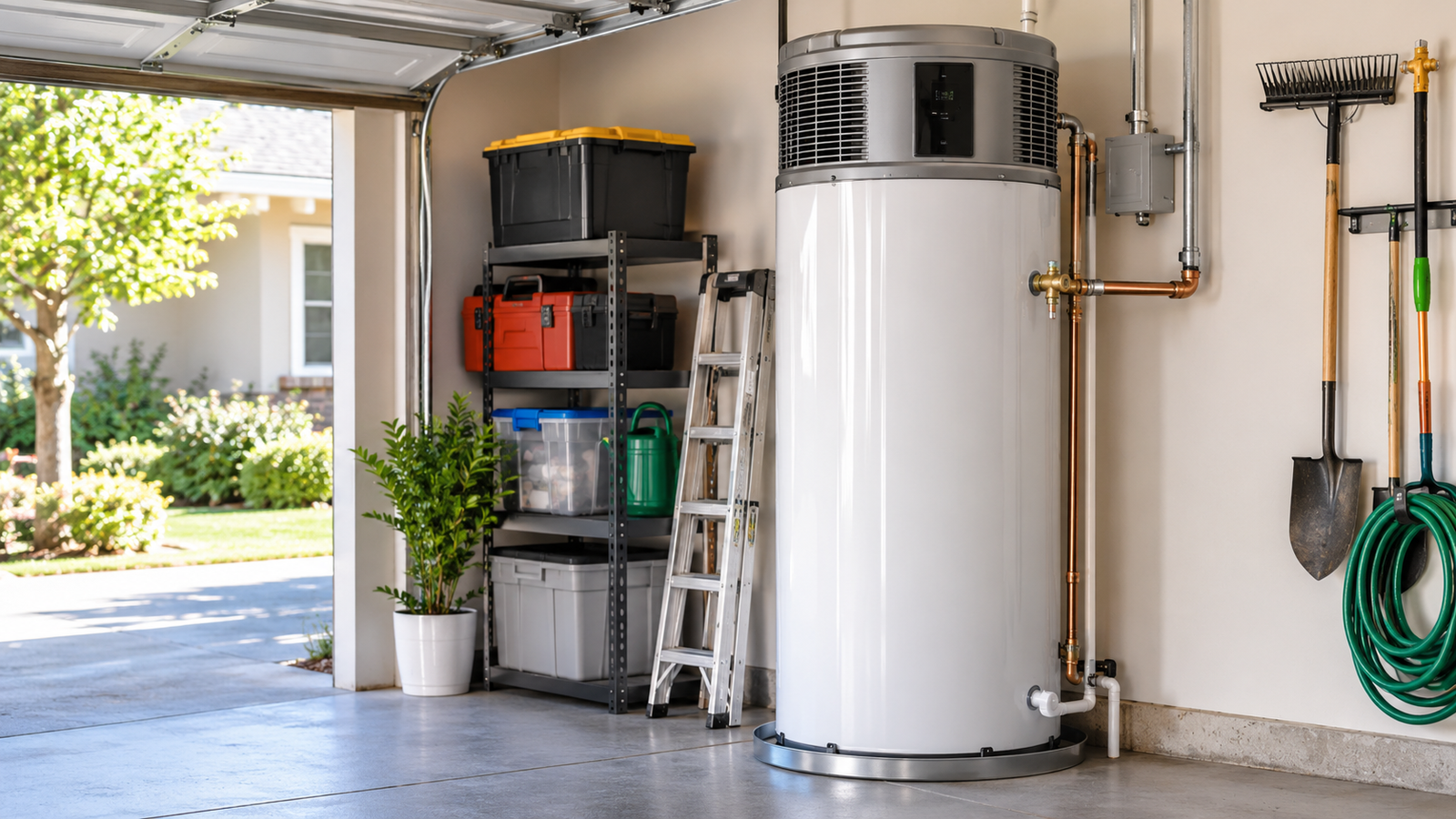
Heat Pump Water Heaters: How They Work, Costs and Savings
A heat pump water heater can produce the same hot water as a conventional electric tank while using substantially less electricity. The difference is how it heats the water: instead of generating heat directly with an electrical element, it pulls thermal energy from the surrounding air and transfers it into the tank.
For homeowners replacing an aging electric water heater, this technology can reduce water-heating costs. ENERGY STAR estimates that a certified model can save a household of four approximately $550 per year compared with a standard electric water heater under its published assumptions. Actual savings depend on electricity prices, household hot water use, installation conditions, and the equipment selected.
There is one detail that deserves attention before buying: a heat pump water heater needs a suitable installation space. It draws heat from the air around it, produces cool exhaust air, and requires a way to manage condensate. A unit that fits physically in a utility closet may not perform well there unless airflow and drainage are addressed.
This guide explains how heat pump water heaters work, how to compare models, what installation involves, and how to estimate whether the higher purchase price makes financial sense.
1. What Is a Heat Pump Water Heater?
A heat pump water heater, often abbreviated as HPWH, is an electric storage water heater that uses heat pump technology to heat domestic water. It transfers heat from the surrounding air into the water stored in its tank.
The process is similar to the way a refrigerator works, but in reverse. A refrigerator removes heat from its interior and releases it into the room. A heat pump water heater takes heat from the room air and transfers it into the water tank.
Most residential models sold in the United States are integrated systems. The heat pump components sit on top of or are built into the storage tank. These units typically include:
- Evaporator: absorbs heat from the surrounding air.
- Compressor: raises the refrigerant’s pressure and temperature.
- Condenser: transfers heat from the refrigerant into the stored water.
- Expansion device: reduces refrigerant pressure before the cycle repeats.
- Storage tank: holds the heated water until the household needs it.
- Electric resistance elements: provide supplemental heating in many hybrid models.
The refrigerant circulates through a closed system. It absorbs heat from the air at the evaporator and releases that heat through the condenser, which transfers energy into the water.
Because the system moves heat rather than producing all of it through electrical resistance, it can deliver more heat energy than the amount of electricity it consumes.
For a broader explanation of the technology behind heat pumps, see our guide, What Is a Heat Pump? A Plain-English Guide for Homeowners.
2. How Does a Heat Pump Water Heater Work?
A heat pump water heater uses electricity to operate its compressor and fan. The fan draws surrounding air across the evaporator coil, where the refrigerant absorbs thermal energy.
The compressor then raises the refrigerant’s pressure and temperature. The hot refrigerant passes through a heat exchanger, transferring energy into the water stored in the tank. After releasing heat, the refrigerant continues through the expansion device and returns to the evaporator.
The cycle repeats until the water reaches the selected temperature.
This process explains why a heat pump water heater can be more efficient than a conventional electric resistance model. A resistance element converts electrical energy directly into heat. A heat pump uses electricity to move heat that already exists in the surrounding air.
Why Are Some Heat Pump Water Heaters Called Hybrid Models?
Many integrated heat pump water heaters include conventional electric resistance elements in addition to the heat pump.
These elements provide backup heating when hot water demand is high, when the heat pump cannot recover the tank quickly enough, or when operating conditions make heat pump operation less suitable.
For example, imagine a household where several people take showers in the morning while a dishwasher is running. The heat pump may need more time to restore the tank temperature after this demand. A hybrid unit can activate its resistance elements to provide faster recovery.
The backup elements make the system more flexible, but they consume more electricity than heat pump-only operation.
Common Operating Modes
Manufacturers use different names for their control settings, but most hybrid models offer several basic modes.
| Operating mode | How it works | Main consideration |
|---|---|---|
| Heat Pump Only / Efficiency | Uses the heat pump to heat the tank | Highest efficiency, generally slower recovery |
| Hybrid / Auto | Uses the heat pump and activates resistance heat when needed | Balances efficiency and hot water availability |
| Electric Resistance | Uses conventional heating elements | Faster recovery, higher electricity use |
| Vacation | Reduces or suspends normal heating during an extended absence | Helps avoid unnecessary energy use |
The exact behavior depends on the manufacturer and model. Read the owner’s manual before changing operating modes.
For everyday use, the manufacturer’s recommended hybrid or automatic setting is often a practical starting point. Homeowners who prioritize maximum efficiency may prefer heat pump-only operation if the tank capacity and household schedule allow it.
A common mistake is leaving the unit in resistance-only mode after a temporary hot water shortage. The system may then operate much like a conventional electric water heater, reducing the expected energy savings.
3. How Much Does a Heat Pump Water Heater Save?
The main financial advantage of a heat pump water heater is lower electricity consumption compared with a standard electric resistance tank.
ENERGY STAR estimates that a certified heat pump water heater can save a household of four approximately $550 per year compared with a standard electric water heater. Its published estimate assumes an electricity price of $0.146 per kWh, an incremental equipment cost of $1,503, and a 13-year product life.
The same estimate shows different annual savings by household size:
| Household size | Estimated annual savings | Estimated lifetime savings |
|---|---|---|
| 2 people | $270 | $2,050 |
| 3 people | $410 | $3,830 |
| 4 people | $550 | $5,610 |
These figures are ENERGY STAR estimates, not guaranteed results for every home. Your actual savings may be higher or lower depending on local electricity rates, water consumption, incoming water temperature, equipment settings, and installation conditions.
What If Your Current Water Heater Uses Natural Gas or Propane?
The financial comparison becomes more complicated when replacing a gas or propane water heater.
A heat pump water heater uses electricity, so the result depends on the cost of electricity relative to the fuel being replaced. In some areas, electricity is expensive enough that savings compared with natural gas may be limited. In other locations, a heat pump water heater may offer a clear operating-cost advantage.
Before making a decision, compare the actual cost of the energy your household uses.
A useful starting point is to collect:
- Your electricity price per kWh.
- Your natural gas or propane price, if applicable.
- Your current water heater’s fuel consumption.
- The estimated annual electricity use of the proposed heat pump water heater.
- The installed price difference between the two options.
Do not use savings estimates designed for electric resistance water heaters as though they apply equally to gas, propane, and oil systems.
How Does the Heat Pump Water Heater Pay for Itself?
The payback period is the time required for energy savings to recover the additional upfront cost.
For example, if a heat pump water heater costs $1,500 more than a comparable conventional electric model and saves $500 per year, the simple payback calculation is:
$1,500 ÷ $500 = 3 years
This is an illustrative calculation, not a prediction for a particular home. It also excludes financing costs, maintenance differences, future utility-rate changes, and any additional installation work.
The most useful comparison is between two complete installation quotes, not just the equipment prices.
4. How Much Does a Heat Pump Water Heater Cost?
A heat pump water heater generally costs more to purchase than a conventional electric resistance water heater. The total installed price depends on tank capacity, equipment model, local labor rates, electrical requirements, plumbing changes, drainage, and permits.
Angi’s published 2026 cost guide reports a national average installation cost of approximately $4,200, with many projects falling between $3,200 and $4,700. These figures are planning benchmarks rather than guaranteed prices. A project requiring a new electrical circuit, additional drainage, or significant changes to the installation location may cost more.
What Affects the Installation Price?
1. Tank capacity
Larger tanks generally cost more than smaller ones. A 50-gallon model may be suitable for one household, while a larger family or a home with several bathrooms may need more storage capacity or a higher first-hour rating.
2. Electrical work
Many 240-volt models require a dedicated electrical circuit. If the existing circuit or electrical panel cannot support the new equipment, an electrician may need to make changes.
Some manufacturers offer 120-volt models designed for different installation situations. Their electrical requirements and recovery performance vary, so compare the specifications rather than assuming every model is interchangeable.
3. Plumbing changes
A replacement may require adjustments to water connections, shutoff valves, expansion tanks, drain pans, or other plumbing components to meet local code and manufacturer requirements.
4. Condensate drainage
Heat pump water heaters remove moisture from the air as part of their operation. The resulting condensate must be routed to an approved drain or collected using a suitable condensate pump.
5. Installation location
A unit installed in a suitable garage or basement may require less preparation than one being placed in a small interior closet. Restricted airflow, limited clearance, and the absence of a nearby drain can increase project costs.
6. Permits and local labor rates
Permit requirements and labor costs vary by jurisdiction. Ask whether the contractor’s quote includes permit fees, inspection arrangements, electrical work, and disposal of the old water heater.
What Should a Written Quote Include?
Before accepting an estimate, check that it identifies:
- Manufacturer, model, and tank capacity.
- Uniform Energy Factor (UEF).
- First Hour Rating (FHR).
- Electrical requirements and any proposed circuit changes.
- Condensate drainage method.
- Required installation clearances and airflow provisions.
- Plumbing materials and modifications.
- Permit and inspection costs.
- Labor, equipment removal, and disposal.
- Warranty coverage and commissioning.
For more information about installation planning and contractor selection, see our Heat Pump Installation: Step-by-Step Guide, Timeline and Costs.
5. How Do You Choose the Right Tank Size?
Choosing the correct capacity is essential. A tank that is too small may run out of hot water during busy periods. A tank that is unnecessarily large may cost more and occupy valuable space.
Start by looking at your current water heater’s capacity. Its nameplate or yellow EnergyGuide label usually identifies the tank volume. This provides a useful reference, but it does not automatically mean the same capacity will work equally well with a heat pump model.
Heat pump water heaters can recover hot water more slowly in heat pump-only mode than conventional resistance tanks. This makes household demand and recovery performance particularly important.
Understand the First Hour Rating
The First Hour Rating (FHR) estimates how much hot water a storage water heater can deliver during the first hour of use, starting with a fully heated tank.
It accounts for both the water already stored in the tank and the heater’s ability to recover during that hour.
A larger tank does not always guarantee better performance if its recovery characteristics are poor. Likewise, a smaller tank with a strong first-hour rating may serve some households adequately.
When comparing models, look at FHR rather than choosing solely by gallon capacity.
What Information Should You Give the Installer?
A qualified installer should consider:
- Number of people living in the home.
- Number of bathrooms and showers.
- Whether showers are used at the same time.
- Frequency of baths.
- Dishwasher and washing machine use.
- Existing tank capacity.
- Incoming cold-water temperature.
- Preferred operating mode and recovery expectations.
A household with four occupants who take showers at different times may have different requirements from a household of four where several showers happen back-to-back.
The right size should be based on actual usage patterns and the manufacturer’s sizing guidance.
6. Where Should You Install a Heat Pump Water Heater?
Installation location has a direct effect on performance.
An integrated heat pump water heater draws heat from the surrounding air. It therefore needs adequate airflow and a suitable ambient temperature range. If the surrounding space is too cold, the heat pump may become less efficient or switch to electric resistance heating, depending on the model.
ENERGY STAR’s consumer guidance recommends an interior installation space that generally remains between 40°F and 90°F throughout the year. Individual products may have different operating limits, so the manufacturer’s installation manual must take priority.
Garage
A garage can be a practical location if temperatures remain within the equipment’s permitted operating range and the unit is protected from weather.
However, a garage in a cold climate may become too cold during winter. Check the model’s minimum operating temperature and make sure exposed plumbing is protected against freezing.
Basement
A basement often provides enough space and can maintain more stable temperatures than an unconditioned garage.
The installer should check available airflow, ceiling height, service clearances, and condensate drainage. A basement floor drain can simplify condensate management, but the drainage arrangement still needs to meet the manufacturer’s requirements and local plumbing code.
Utility Room
A utility room may work if it has sufficient air volume or a properly designed ventilation arrangement.
A small, sealed closet can restrict the air supply. Some installations use louvered doors or ducting to provide the required airflow. The exact configuration depends on the equipment and the room.
Does a Heat Pump Water Heater Cool the Room?
Yes. Because the unit extracts heat from surrounding air, it releases cooler air back into the installation space.
This effect can be useful in a warm garage or basement during summer. In winter, however, it may create an additional heating demand if the unit is installed inside a conditioned area.
ENERGY STAR notes that the cooling effect is localized and that its impact on the home’s overall heating system depends on the location and layout. Avoid placing the unit close to a thermostat or in a frequently occupied space where the cooler air would be uncomfortable.
Does It Make Noise?
A heat pump water heater contains a fan and compressor, so it produces sound while heating water.
The noise may be noticeable if the equipment is installed near a bedroom, home office, or quiet living area. A garage, basement, or utility room away from regularly occupied spaces is often a better choice.
Check the manufacturer’s published sound rating before selecting a model.
7. What Is Involved in Installing a Heat Pump Water Heater?
Replacing a conventional electric water heater with a heat pump model may be relatively simple if the existing location already meets the new unit’s requirements.
A conversion from gas to electric can involve additional work, especially if the home needs a new electrical circuit or changes to the water heater location.
A typical project includes the following steps:
- Evaluate the existing system. The contractor checks the current heater, plumbing connections, electrical supply, installation space, and household hot water requirements.
- Select the equipment. The installer compares tank capacity, FHR, UEF, operating temperature range, electrical requirements, dimensions, and warranty.
- Prepare the installation area. The space is checked for airflow, service access, clearance, condensate drainage, and protection against water damage.
- Remove the old water heater. The existing tank is disconnected and removed in accordance with applicable safety requirements.
- Install the new unit. The contractor connects the water lines, electrical supply, condensate drain, and any required accessories.
- Test the system. The installer checks for leaks, verifies electrical operation, confirms condensate drainage, and reviews the operating controls.
- Explain the settings. The homeowner should understand the available modes, temperature settings, filter maintenance, and warranty requirements.
The electrical and plumbing work should be completed by appropriately qualified professionals. Follow the manufacturer’s instructions and local building and plumbing codes.
Electrical Requirements
Many conventional 240-volt heat pump water heaters use a dedicated electrical circuit. Some models have different electrical requirements, including certain 120-volt plug-in options.
Do not assume that an existing water heater circuit will automatically support the new model. Have a qualified electrician verify the circuit, breaker, wiring, grounding, and panel capacity.
Condensate Drainage
The heat pump process removes moisture from the air, producing condensate.
The water must drain safely away from the equipment. Depending on the installation, the contractor may use a gravity drain or a condensate pump.
The drain line should be installed according to the manufacturer’s instructions, with protection against freezing where necessary. A blocked or incorrectly routed condensate line can cause water leaks around the unit.
Installation Space and Airflow
The unit needs enough surrounding air to operate efficiently. ENERGY STAR technical guidance gives different space and airflow recommendations depending on the installation configuration and equipment.
Some models can use ducting to draw air from or discharge air into an adjacent space. Others may require a minimum room volume or specific ventilation arrangements.
Do not rely on a generic room-size rule. Ask the installer to document the exact clearance and airflow requirements for the selected model.
8. What Are the Advantages and Disadvantages of Heat Pump Water Heaters?
A heat pump water heater can be a strong option for households replacing an electric resistance tank, but it has practical requirements that should be considered before purchase.
Advantages
- Lower electricity consumption: uses heat transfer rather than relying entirely on electric resistance heating.
- Potentially lower utility bills: savings can be substantial compared with standard electric tanks, depending on local rates and hot water demand.
- No on-site combustion: an electric HPWH does not burn natural gas, propane, or oil to heat water.
- Hybrid operation: many models include resistance backup for periods of high demand.
- Useful cooling effect: the surrounding area receives cooler, dehumidified air while the heat pump is operating.
- Multiple control options: some models offer scheduling, vacation settings, connected controls, and energy-use monitoring.
Disadvantages
- Higher upfront cost: equipment and installation generally cost more than a basic electric resistance water heater.
- Slower recovery in efficient modes: heat pump-only operation may take longer to restore the tank temperature after heavy use.
- Space requirements: integrated units need sufficient airflow and installation clearance.
- Cooling and noise: the fan and compressor produce sound and cool the surrounding space.
- Condensate drainage: the installation requires a suitable drainage arrangement.
- Cold-space limitations: performance can decline in low ambient temperatures, and some models may rely more heavily on resistance heating.
The balance depends on the home. A homeowner replacing an electric resistance tank in a suitable basement may have a strong case for an HPWH. A homeowner replacing a gas heater in a home with high electricity prices may need a more detailed cost comparison.
9. How Do You Maintain a Heat Pump Water Heater?
Heat pump water heaters require routine attention to keep airflow, drainage, and water-heating performance in good condition.
The maintenance schedule depends on the model and installation environment. Always follow the owner’s manual rather than applying a generic schedule to every unit.
Common maintenance tasks include:
- Clean or inspect the air filter. Dust and debris can restrict airflow and reduce heat transfer. Follow the manufacturer’s instructions for cleaning or replacement.
- Check the condensate drain. Make sure water can flow freely and that the drain line is not blocked.
- Inspect the surrounding area. Keep the air intake and exhaust paths clear of stored items, dust, and obstructions.
- Check for leaks. Look around plumbing connections, the tank base, and the condensate line.
- Review operating settings. Confirm that the unit has not been left in resistance-only mode unintentionally.
- Follow tank maintenance instructions. Sediment management, anode inspection, and other water-heater maintenance requirements depend on the model and local water conditions.
Some maintenance tasks can be performed by homeowners if the manufacturer permits them. Electrical repairs, refrigerant-system work, and internal component servicing should be left to qualified technicians.
10. Is a Heat Pump Water Heater Worth It?
For many households with standard electric resistance water heaters, a heat pump water heater is worth evaluating because the potential operating-cost savings can offset its higher purchase price.
The financial case is less predictable when replacing a gas or propane water heater. Electricity prices, fuel prices, installation costs, and the household’s hot water consumption can change the result significantly.
Before choosing a model, compare the following:
| Factor | What to check |
|---|---|
| Current water heater | Fuel type, age, capacity, and operating cost |
| New equipment | UEF, FHR, tank size, and operating temperature range |
| Installation | Electrical circuit, plumbing, airflow, and drainage |
| Utility rates | Local electricity and current fuel prices |
| Household demand | Number of occupants and peak hot water use |
| Total cost | Equipment, labor, permits, and additional work |
| Financial incentives | Current state, utility, and local programs, if available |
A heat pump water heater is most attractive when the home has a suitable installation location, the household uses a meaningful amount of hot water, and electricity prices make the operating savings worthwhile.
If your current water heater is still functioning, planning ahead gives you time to compare models and obtain multiple quotes. Waiting until a tank leaks or stops working can leave you with fewer equipment and installation options.
Frequently Asked Questions
How much electricity does a heat pump water heater use?
Electricity use depends on tank size, water consumption, incoming water temperature, operating mode, ambient temperature, and equipment efficiency. ENERGY STAR publishes estimated annual energy use and savings for certified models. Check the EnergyGuide label for the specific unit rather than relying on a single average.
Can a heat pump water heater replace a gas water heater?
Yes, but the conversion may require electrical work and changes to the installation setup. A 240-volt circuit, additional tank capacity, condensate drainage, or a different location may be needed. A qualified contractor should evaluate the home before the equipment is selected.
Do heat pump water heaters work in cold climates?
They can, provided the selected model is installed within its approved operating conditions. Integrated units generally perform best in spaces that remain within the manufacturer’s recommended temperature range. In colder locations, the installer should verify whether the unit will rely on resistance heating during winter.
How long does it take to heat a full tank?
Recovery time varies by tank capacity, model, incoming water temperature, ambient conditions, and operating mode. Heat pump-only operation generally takes longer than electric resistance heating. Check the manufacturer’s performance data for recovery information.
Can a heat pump water heater be installed in a closet?
Sometimes. The closet must provide adequate airflow, service clearance, and condensate drainage. Depending on the model, this may require a louvered door or ducting. A small sealed closet should not be assumed suitable without checking the installation manual.
Does a heat pump water heater work during a power outage?
No. It may continue to supply the hot water already stored in the tank, but it cannot heat additional water without electricity. Both the compressor and any electric resistance backup elements require power.
Is a heat pump water heater more efficient than a tankless water heater?
It depends on the type of tankless heater and the comparison being made. A heat pump water heater can be substantially more efficient than a standard electric resistance tank. Comparing it with a gas tankless model requires local electricity and gas prices, equipment efficiency, and household usage.
Do heat pump water heaters need a special drain?
They need a suitable way to remove condensate produced during operation. This may be a gravity drain or a condensate pump, depending on the location. The installation must follow manufacturer instructions and local plumbing requirements.
Important Cost and Savings Note
The prices and savings figures in this guide are estimates based on published sources and stated assumptions. They are not guaranteed results for every household. Actual equipment and installation costs vary by location, tank capacity, electrical and plumbing requirements, and project complexity. Actual energy savings depend on household hot water use, utility rates, operating settings, and installation conditions.
Before purchasing a unit, obtain a written quote from a qualified contractor and compare the estimated annual operating cost with your current water heater. Check local utility and state incentive programs separately, because eligibility and availability can change.
Disclaimer: This article is for general informational purposes only and is not a substitute for professional plumbing, electrical, or HVAC advice. Installation must follow the manufacturer’s instructions and applicable local codes. Electrical modifications and plumbing work should be performed by appropriately qualified professionals.